
There have been many memorable Jeep® concept vehicles over the years, but few made as strong an impression on the auto show circuit as the 2007 Jeep Trailhawk Concept. Designed to blend the core off-road capability of the body-on-frame (BoF) four-door Jeep Wrangler Unlimited (JK) with a more refined, road-focused SUV profile, the Trailhawk delivered a fresh and unexpected take on open-air Jeep performance.
Exterior Design –

“The key to the look of the Trailhawk,” said Nicho Vardis, Principal Exterior Designer, “is the vehicle’s distinctive proportions, due in part to its 116-inch wheelbase. The dash-to-front-axle dimension is dramatically long, giving the car a sense of forward motion, while the front and rear overhangs are tight and abbreviated.”
The Trailhawk’s bodyside was muscular and broad-shouldered, with sheet metal pulled taut to emphasize motion even at a standstill. Even the pillars were swept rearward, reinforcing the vehicle’s aggressive stance. A rising beltline added to the sense that the Trailhawk was always poised to pounce.
The wheels were pushed to the corners and wrapped in robust trapezoidal fender flares. While clearly geometric, the flares avoided symmetry.
“The flares are stretched and pulled taut at one end,” Vardis said. “Each presents a ‘long side’ angled toward the center of the body.”

Rolling stock consisted of massive 22-inch five-spoke wheels wrapped in 34-inch tires, each accented by a red stripe that echoed the red-painted exposed brake calipers. The lower body flared outward along the door bottoms, intersecting the wheel arches crisply. Beneath this element sat a recessed running board with silver accent trim. A tall trapezoidal vent at the front fender-to-door cutline housed the iconic Trail Rated badge.
Up front, the long hood flowed into Jeep’s signature seven-slot grille, angled slightly rearward to match the lean-back geometry of the front fender flares. The grille openings were filled with mesh, while the headlamps mirrored the same rearward stance.
“The main headlamp units are cropped diagonally across the top,” said Vardis. “They peer out from an angled brow, giving the vehicle its bold, sinister look. In front view, the left and right lamps evoke the hooded eyes of a bird of prey.”
The headlights featured HID projector quad lamps set within polished aluminum “telescopic” barrels, while LED parallel stripes handled park and turn signal duties.

“Like other concepts, we first viewed the math surface of the grille and headlamps together in the computer,” added Vardis. “We immediately noticed the hawkish expression, hence the name ‘Trailhawk.’”
At the rear, the taillamps echoed the front lighting signature, including striped turn signals. The greenhouse was encircled by a crisp, chamfered 360-degree molding, emphasizing the high, arching beltline. A seven-slot cowl screen at the base of the windshield subtly reprised Jeep’s grille motif.
The body was finished in Argent Pearl high-gloss paint, contrasted by slightly darker low-gloss flares and lower-body cladding to enhance the Trailhawk’s width and visual toughness.
Open-Air Freedom –

One of the Trailhawk Concept’s most impressive features was its commitment to open-air driving. The side windows fully retracted into the body, eliminating the B-pillar above the beltline. Diagonal quarter windows were also fully retractable. Gray-tinted longitudinal glass roof panels over both seating rows, along with the cargo-area glass and swing-up backlight, were all removable.
With all glass lowered or removed, the Trailhawk offered an open-air experience comparable to a soft-top Wrangler. A fixed central spine housed overhead lighting and multiple integrated storage bins.
“The Jeep Trailhawk interior emphasizes the vehicle’s open-air freedom, inviting elements of the exterior theme into the interior,” said Cliff Wilkins, Principal Interior Designer. “Tough mechanical elements which evoke exterior details are contrasted with sophisticated materials and finishes to give a modern, rugged, purposeful interior while delivering a premium off-road experience.”
Interior Design –

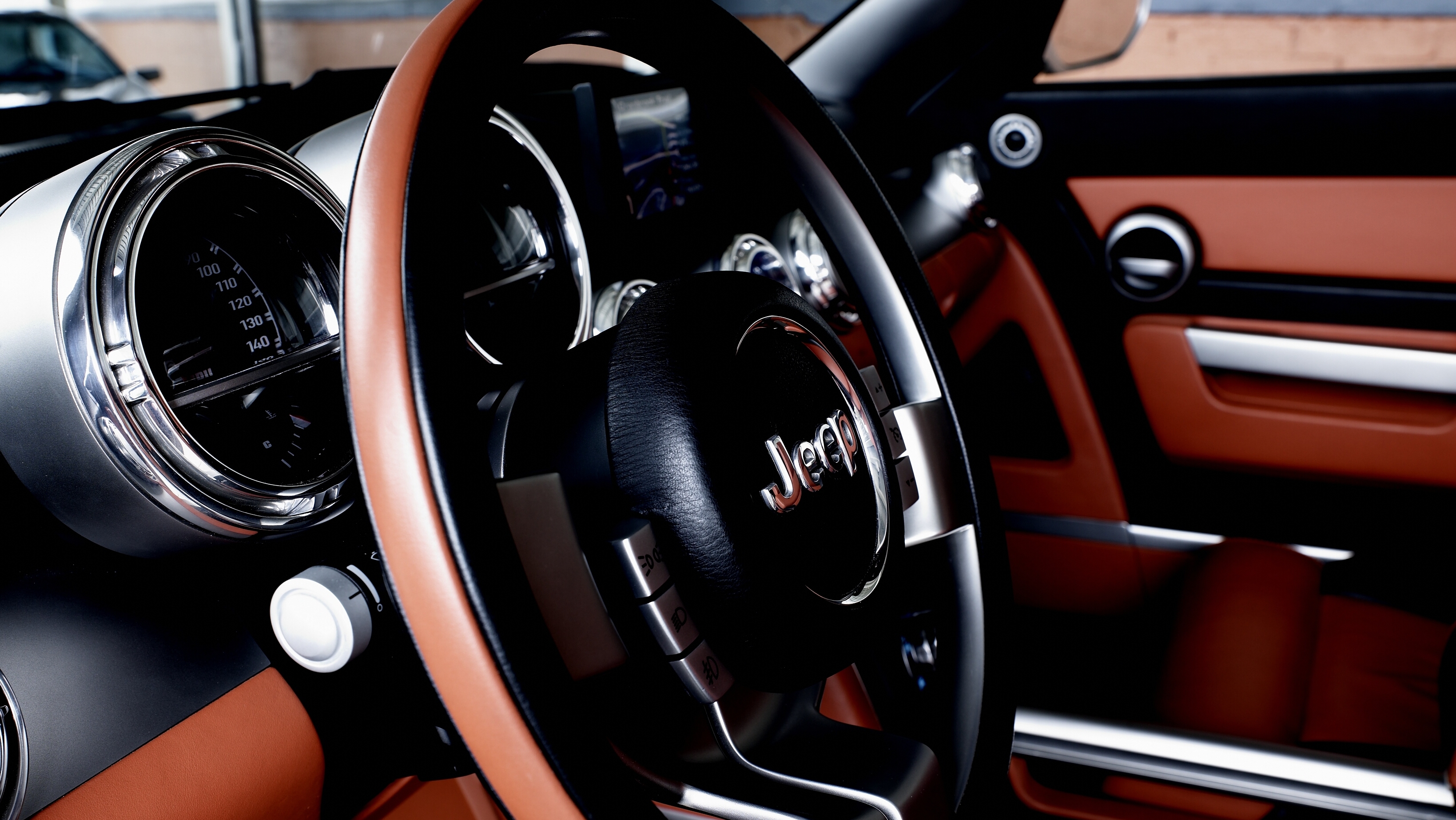
The four-passenger interior centered on two dominant design elements: a bold cross-car instrument panel and a full-length central spine forming the floor console. Circular machined-aluminum-style housings—matching the headlamp detailing—contained the AC outlets, center stack compass/inclinometer, and dimensional double-deck “biplane” gauges.
The two-tone leather-wrapped aluminum steering wheel featured individual vertical switches for lighting and speed control. The raised console walls formed a full-length open bin, ideal for storing everyday gear. Two front/rear combination armrest and storage modules slid along concealed tracks, allowing occupants to position them fore or aft as needed.
Using then cutting-edge laptop-style touchpad technology, a flip-out pad controlled the fold-away flat-screen navigation system, housed within the forward armrest.

“The open console’s unique utility is enhanced by the relocation of the transfer case ‘Terrain Selector’ switch to the center stack of the I/P,” said Wilkins. “Also, there is the use of an electronic gear selector/park brake lever mounted to the right side of the steering column to continue this effect.”
Additional storage appeared ahead of the drop-open center stack control module and within the lower door trim panels. Seating was finished in Bark Black and Firewood Orange premium leather, while the floor featured a durable spray-on coating with integrated non-slip heel pads.
In the cargo area, removable portable audio pods were housed in each rear quarter panel—an idea that would later reappear on the production Jeep Gladiator. Each pod included a dock for an MP3 player, a very on-trend feature for the mid-2000s.

Jerry-can-style Firewood Orange storage boxes mounted ahead of the audio pods provided space for first-aid kits or roadside gear. A drop-down tailgate incorporated concealed storage, four cup holders, and a sliding Load ’N Go cargo tray with movable partitions that rolled rearward for easy access.
“One of the most remarkable things about the interior,” concludes Wilkins, “is that it was designed and surfaced entirely electronically — there were no traditional sketches or 3-D models. Even so, the interior turned out just as we had envisioned.”
Lasting Influence –

The 2007 Jeep Trailhawk Concept previewed numerous design cues that would later appear on the 2011–2022 Jeep Grand Cherokee (WK2). From its aggressive proportions to its refined-yet-rugged execution, the Trailhawk remains a standout example of Jeep’s design ambition.
Even after almost 19 years after its debut, the Trailhawk Concept still looks bold, purposeful, and remarkably forward-thinking—a reminder of just how daring Jeep design could be when unconstrained by production realities.
2007 Jeep® Trailhawk Concept Image Gallery: